On Ambiguity
Coming to terms with a lack of terms

I am not a patient person. Whereas one’s lack of patience may usually connect to a similarly poor temperament, my shortage reveals an unnerving anxiety. Beyond the bounds of what I think is likely lies a dreaded uncertainty—a terror my brain will, it seems, do anything to avoid. If a waiter has taken longer than expected to bring me my check, I will assume he’s forgotten about us. My brain, pleased to have definitively and incontrovertibly diagnosed the situation, will then wonder how much longer I should wait before I get up. Fifteen minutes? Twenty? An hour? Can any waiter get me my bill? How does one get a bill? If I don’t pay my bill, and they close, will I be locked inside? Hold on, is that our waiter? And on, and on, until the certainty my brain seemed to, only a moment ago, hold with such ferocity dissolves as the waiter comes to our table with the bill.
My brain never does seem to learn the lesson from these situations. No longer hypnotized by the unknown, it snaps quickly back into the internal monologue that runs my life. My consciousness has returned control, and it is entirely uninterested in discussing why or how this happened, or might happen again. No! The situation is resolved. Sometimes, though, the situation is not resolved. Sometimes my brain is forced to undergo what it may hate more than anything in this world: ambiguity.
Ambiguity is the older brother of uncertainty, but with a fancy Ivy League degree in Communications and a motorcycle. Whereas uncertainty promises some hidden clarity within it, ambiguity proudly rejects the idea that clarity is to be wanted at all. No, ambiguity instead suggests that the real excitement is found in not knowing—in letting the lazy river of life drift you along from event to event. Even if ambiguity may often hide some deeper emotion—or more accurately a mix of conflicting ones—it considers it none of your business to find out. Unlike its little brother, ambiguity gets to play coy when it wants to play coy, and be bold when it wants to feel bold. And, as most older brothers are, ambiguity is cool. It knows you know it’s unkempt and unfair, and it knows you will keep wanting anyway.
I’ve been thinking about ambiguity after my Instagram feed has become flooded with a very specific type of post: a wall of text either decrying, acknowledging, or celebrating a “situationship”. Some ask rhetorical “would you rather” type questions where one answer is cartoonishly violent and the other is about your situationship taking a day to respond. Others are character descriptions specific enough to be a tool for the viewer: hit like and maybe that person will see. Maybe you need your own motorcycle and then, and only then, will this ambiguity become tolerable.
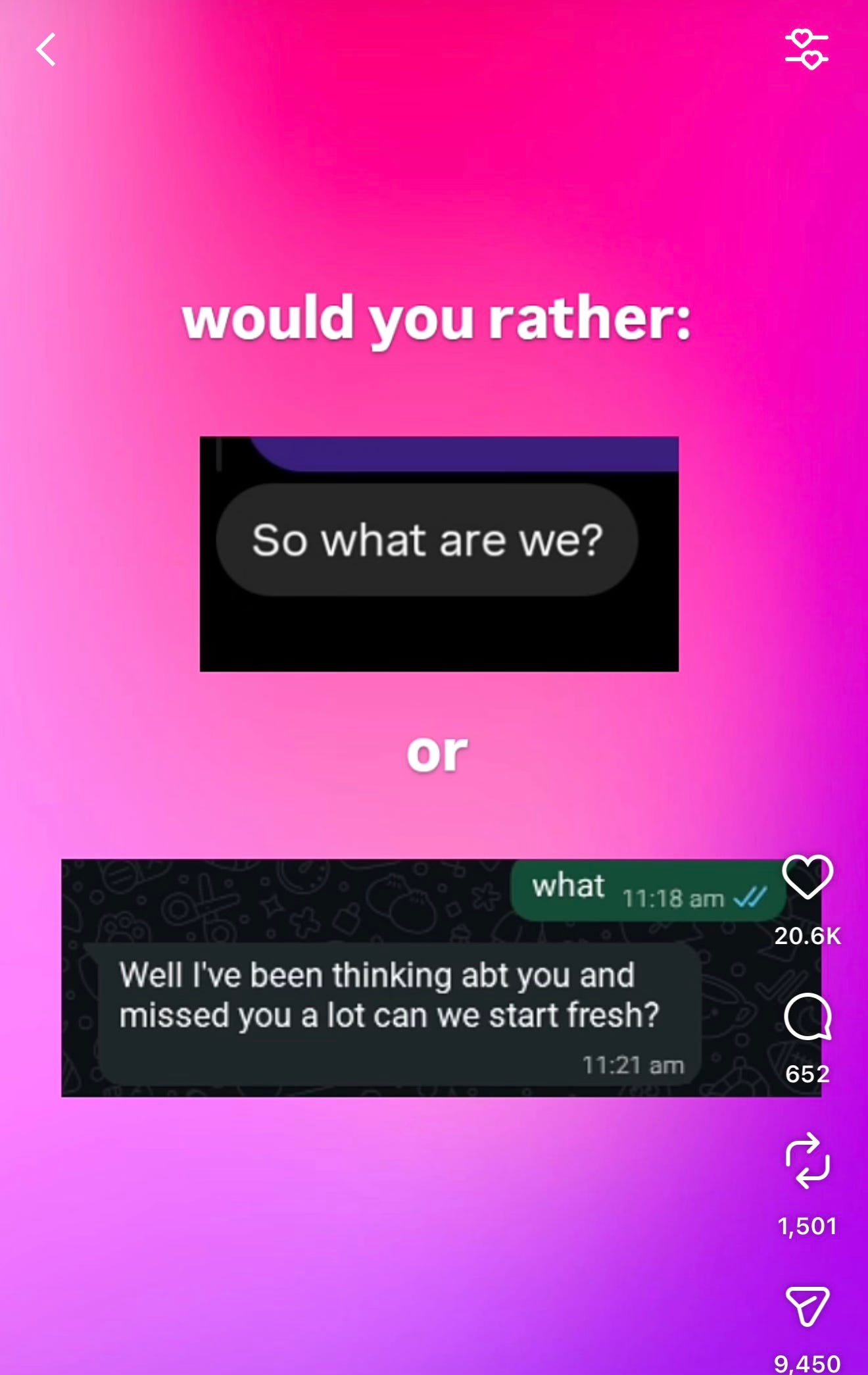
I am, needless to say, not the target audience for this content. Still, I find myself oddly captivated by these posts. There’s something about them that I find so incredibly alluring—a way of thinking so radically different from my own that it feels almost alien. This alien feeling of course does not come from the idea of an unrequited courtship—liking someone who does not like you back is a universal experience. These posts are so different, I think, because they go past that. They venture out into the vast empty space of relationships where the connection is enough to start something but not to sustain it. In this, surrounded by the bodies of relationships old, is a definite romanticization. That—the inclination to romanticize what I would find to be so dreadful—is the origin of my interest.
My need for immediate answers is not restricted to a slip of thermal paper and a twenty-five percent tip. I revile the type of relationships, if you can even call them that, in which these videos revel. I revile it not out of judgment for others’ decisions but out of a perfectly clear-hearted and decidedly self-centered view on what is needed to make a life of real substance. A life that is worth living in the moment and reminiscing after it—a richness of people, places, and things all stacking upon each other.
But let’s take a step back. Before I explain why these traits are non-negotiable in a partner, I want to first specify why exactly the former is so lacking to me. Firstly, and most importantly, a partner who cannot give us certainty in their decisions and clarity in their personality is not a partner at all. Instead, you are a prisoner—locked in a cell that you can always technically leave but to which you’ve grown inured. You’ve grown accustomed to whatever deficits you once rejected in your suitor, no longer feeling any true unhappiness when a message is left on delivered for twelve hours. That angst has been replaced with a faux despair, going through the motions of real discontent and all the while deriving your sense of superiority from this interaction. You, the emotionally-intelligent-earnest-communicator, left at the altar again with only your good intentions to blame.
By doing this, we are surrendering our most important trait: kindness. Deriving meaning in the absence of what another has is not actually creating anything for ourselves. We are not funnier because another is not, nor are we smarter, but we certainly are crueler. We lose that ability to look at another’s Instagram account without immediately deciding if this person is performative or pretentious. We analyze every story as if it was posted for our eyes only. We take what we want from their actions—or perhaps their non-actions—and leave the rest as a sorry coincidence.
Maybe, though, that shy cruelty is in part what I am so drawn to in the first place. There’s something undeniably enticing about feeling that you are in some type of in-group comprised of people whose only fault is being too aware. By bemoaning what they don’t have, you’re also showing what you do. All you are asking for is reciprocity—a hope that even without firm labels, you can still have all the good parts of “boyfriend” and “girlfriend” that tether people. Because, without that, a situationship is still ultimately just two people, each with two different sets of reasons, living two different versions of a relationship.
In a way, I think my need for certainty is no different than this need for exactly the opposite. Whether you get on a motorcycle of your own and ride alongside ambiguity, or you play eye tag with a waiter for thirty minutes, you are demanding something which cannot be demanded. That is easier for me to write than to understand. I am certainly always going to be someone that believes a situation is better shaped by me than anyone else. I am never going to love the twelve hours spent pretending the person I’m talking to is working an all-nighter in a coal mine. But it is, I increasingly think, not only a waste of time to try and insulate yourself from others’ actions but a waste of life. So, I am trying to let go of that—to stay in the moment of the situationship, or relationship, or whatever term you want to use to describe what pulls us towards another.