

The Extraordinary Ordinariness of Lindsey Graham
By making himself useful to Trump, Lindsey Graham preserved the foreign policy MAGA had promised to bury.

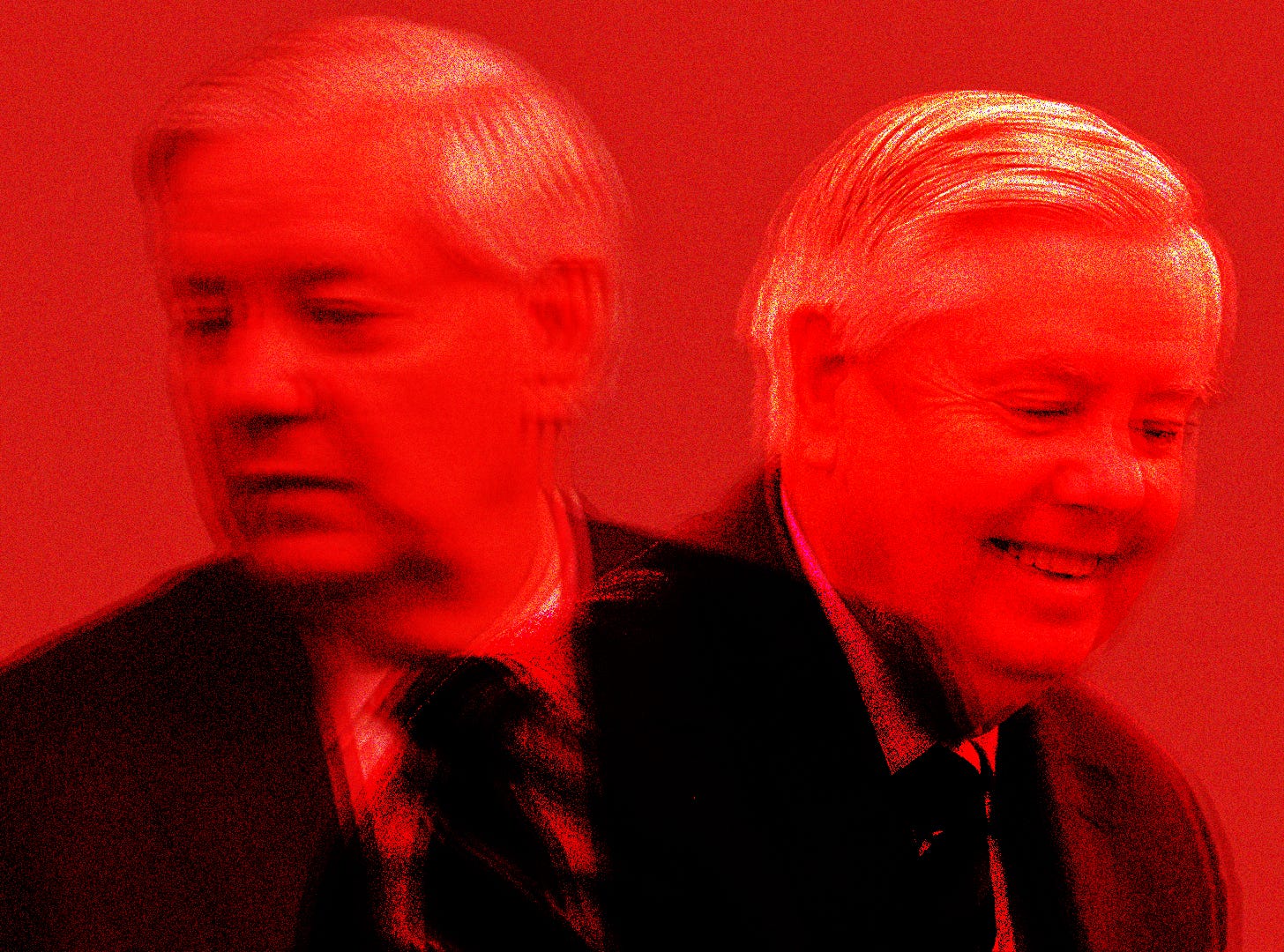
In every presidential race, there are a handful of candidates who make you wonder, “How in the hell do they think they have a chance?” Men and women so uncomfortable with the spotlight and unconvincing in their convictions that their presence in an Iowa fairground or New Hampshire living room feels deeply out of place. Most of the time, these characters fade into the background of public life—dropping out a few months before any voting takes place. Their dozens of supporters quickly assimilate to the actually viable candidates who shared all their former opponent’s views, and could smile on television too.
In most timelines, Lindsey Graham is just another one of these characters. A man completely ordinary in his convictions and undeniably average in his willingness to stand behind them. A man who, like most of the establishment GOP in the dog days of the 2016 election, fought against Trump because he said the quiet part out loud. Who, like most of the establishment GOP soon after, would suddenly embrace a President they so clearly reviled and defend the policies they had so recently rebuked. Yet, even with all of Lindsey Graham’s uncompromising unoriginality, he was able to do what no other figure in the old guard of the GOP could: see the hollowness of the MAGA movement and the vainglory of its leader as the greatest opportunity the neoconservative movement would ever have to keep its iron grip on power. In this way, Lindsey Graham was every bit an extraordinary man.
Whereas the rest of the Republican establishment spent the first few years of Trump 1.0 trying, and failing, to use him as a Trojan horse for a Rubio- or Bush-style policy agenda, Graham knew better. He understood that the days of a Republican Party that preached bipartisan immigration reform were over. That to say that immigration could even be reformed implied that there was something redeemable about immigration to begin with—a nonstarter for President Trump and his base. Graham saw that the most prudent move for the “Growth and Opportunity” wing of the party was a tactical retreat away from domestic policy and towards foreign policy—where his hawkish beliefs meshed with President Trump’s affection for displays of power. It was a bet that would pay out more than he could have ever imagined.
Here is where it feels important to stop and acknowledge: for a man as uninspiring as Lindsey Graham was to accumulate as much influence as Lindsey Graham did, he could not be afraid of shame. During the first resist movement in Trump 1.0, liberals online would take great pleasure in sharing old quotes and videos of Lindsey Graham and others denouncing Trump and Trumpism. The hope here, however slim, was that honor and honesty would be enough to nudge the old guard out and into the open—that all the anonymous GOP senators and congressmen would say in public what they said in private.
The fatal flaw of this belief was the fact that shame was the only way Trumpism could sustain itself. Shame was what bonded Trump and his supporters together throughout the 2016 election—the bond growing tighter each time Jeb Bush or Mitt Romney took a swing. So it was that when Trump did pull off his shocking victory, shame would be altogether necessary if the Republican Party wanted to have any hope of a successful first term. The bending of the knee that Trump demands does not require a true change of heart; it in fact prefers you continue to seethe quietly. It revels in making Republicans bend over backwards, and then bend over again, to see how much it can make them say or do. This was a task that Lindsey Graham was uniquely capable of achieving, and one he used to his advantage in appearing ever more deferential in public and ever more powerful in private.
With his never-ending humiliation ritual accepted and embraced, Lindsey Graham could go on with the more important work of turning Donald Trump into the most powerful Neocon on the face of the planet. Graham was smart enough to see that Trump’s foreign policy beliefs were far from settled, save for a general distrust of international agreements and alliances that were, in the eyes of the President, screwing America over. Graham understood that Trump’s famous rebuke of the war in Iraq during the primaries was far more a reflection of his disgust with losers and infatuation with being right about everything before everyone else, than a well-thought-out doctrine of how America should behave abroad.
Trump also offered Graham something that no other President, even George W. Bush, could provide: war with Iran. A war so obviously disastrous and deeply unpopular that no other President would go anywhere near it. Only Trump, whose 2024 campaign had been bankrolled by a network of influential pro-Israel megadonors, could be swayed towards what was promised to be a decisive show of American power. Only Trump, who saw the GOP as a useful vessel for what was ultimately his political movement and his political movement alone, could take an action so deeply unpopular that it would tank support for Republican candidates in the midterm cycle. Only Trump could command those same Republican candidates to fall in line and support this war out of a fearful servility.
In the end, Lindsey Graham was right when he said, “Trump is MAGA.” For all of the many unremarkable parts of Lindsey Olin Graham, his ability to put policies over pride was entirely singular. If only those policies weren’t the relentless demand for the deaths of Middle Eastern children, the endless destruction of Middle Eastern nations, and the tireless defense of a broken U.S.-Israel relationship. He will forever remain a reminder to all of us that you don’t have to enjoy the spotlight or hold strong convictions in order to unmistakably and irreversibly reach out your hand and bend the arc of history your way.
“I’m tired of beating on Bush. I miss George W. Bush. I wish he were president right now.”
—Lindsey Graham, December 15, 2015
